Free DWG waste collection truck blocks
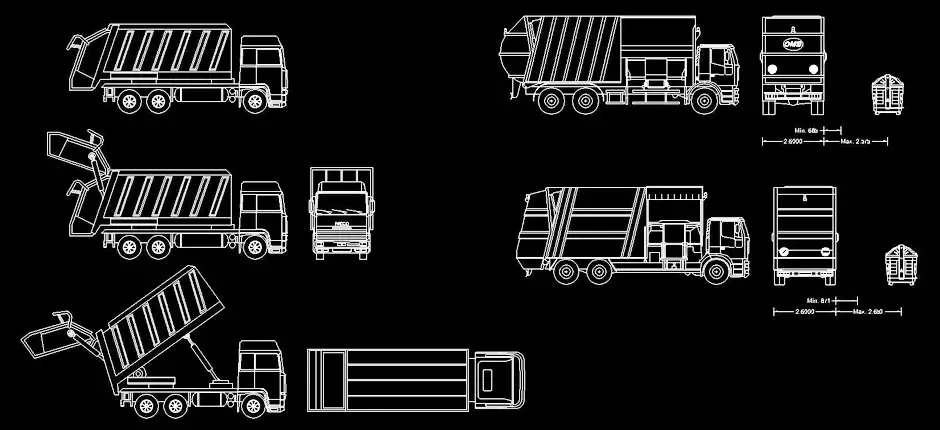
This set of Free DWG waste collection truck blocks provides clean 2D drawings created for fast use in transport, architecture, urban planning, and technical layout projects. The proportions are carefully prepared so the vehicles can be inserted into professional drawings without extra redrafting, while keeping a clear graphic style, consistent scale, and good overall readability.
The file includes plan views, elevation views, and operating positions, making these Free DWG waste collection truck blocks easy to place in many types of CAD documents. They are especially useful for urban road layouts, waste storage areas, technical loading zones, and municipal service plans. The linework remains simple and precise, so the block can be adapted to either schematic drawings or more detailed technical presentations.
These blocks are also practical for parking studies, traffic diagrams, construction logistics, service access plans, and infrastructure design. They help assess passage widths, maneuvering space, visual clearance, and the actual footprint of a waste collection vehicle within a defined area. For more accurate project integration, the block can be scaled, moved, copied, or added to a larger DWG symbol library.
The DWG file can be imported into AutoCAD, AutoCAD LT, AutoCAD for Mac, and other native DWG-compatible AutoCAD alternatives such as BricsCAD, ZWCAD, DraftSight, GstarCAD, progeCAD Professional, nanoCAD, and CMS IntelliCAD. It can also be used in BIM and architectural software including Autodesk Revit, Archicad, Vectorworks, Allplan, and SketchUp Pro.
In addition, these Free DWG waste collection truck blocks can support work in mechanical CAD and 3D modeling environments such as SolidWorks, Autodesk Inventor, Autodesk Fusion, and Rhino 3D, as well as free or open-source solutions like LibreCAD, QCAD Professional, and FreeCAD. Depending on the software used, it is recommended to verify units and scale after import.
Another advantage of this block is its flexibility in technical documentation. It can be used to prepare layout alternatives, compare planning options, or improve presentations without drawing waste collection trucks from scratch. This saves time while maintaining a neat, consistent, and professional representation across the entire project.